




How to Perform Shelf Temperature Mapping in Freeze Drying
A Practical 5-Step Guide to Reliable Shelf Temperature Mapping Studies
Why Shelf Temperature Mapping Matters
Verify Shelf Temperature Uniformity Across All Shelves
In pharmaceutical freeze-drying, the shelf temperature is one of the most critical process parameters. The heat supplied through the shelves directly influences the sublimation rate and therefore the efficiency and safety of the lyophilization process.
By performing shelf temperature mapping, you can verify temperature uniformity across all shelves and ensure consistent heat transfer for every vial in your batch.
These studies also help identify temperature variations and confirm that the freeze dryer operates within specification.
Prevent Product Collapse & Optimize Drying Performance
Poor shelf temperature uniformity can lead to uneven drying conditions. If the product temperature rises above the collapse temperature (or eutectic point), the product structure may collapse and compromise the entire batch.
On the other hand, temperatures that are too low may significantly extend drying time and reduce process efficiency.
By performing proper shelf mapping, you can ensure that the product remains within safe process limits and that the lyophilization cycle runs efficiently and reliably.
Regulatory Guidance for Shelf Temperature Distribution
Shelf temperature distribution studies are referenced in ISO 13408-3 (Aseptic Processing of Health Care Products – Lyophilization). The standard provides the following guidance:
ISO 13408-3 Guidance
- Shelf temperature distribution studies shall be performed to identify inter- and intra-shelf variations and demonstrate conformance to specification.
- Ideally these studies should be performed with the chamber at atmospheric pressure and include a range of temperatures that reflect both the heating and cooling phases of the lyophilization cycle.
- The number of temperature sensors used shall be specified.
7 Must-Have Capabilities for Freeze Drying Measurement Equipment
To perform reliable shelf temperature mapping, you need measurement equipment designed to operate under the demanding conditions inside a freeze dryer.
During mapping, sensors must measure surface temperature accurately while operating under vacuum and across a wide temperature range. The right system will allow you to monitor shelf temperature without interfering with the freeze drying process itself.
When selecting your system, make sure it provides:
- Minimally Invasive Surface Sensors
Sensors should be non-conductive, minimally invasive, and non-self-heating, with a single-point measuring tip that can be placed in direct contact with the shelf surface. - Wireless Measurement Technology
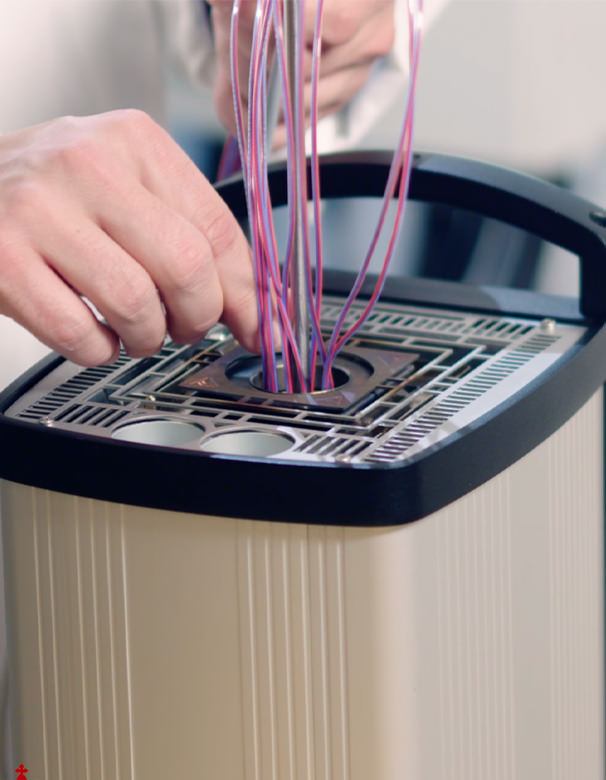
A wireless data logger for lyophilization allows you to place sensors directly inside the chamber without running cables through the freeze dryer wall, which could compromise the vacuum seal. - Direct Shelf Surface Contact
The system should use small, replaceable thermocouple sensors that allow direct contact with the shelf surface to ensure accurate heat transfer - Compact Logger Design
Wireless data loggers should ideally match the size of standard vials. This makes them suitable for freeze dryers with automated vial loading and unloading systems commonly used in pharmaceutical manufacturing. - Wide Operating Range
Your measurement system should operate reliably across the full lyophilization temperature range, typically -60 °C to +60 °C, and under pressures as low as 0.001 hPa. - Unattended Operation for Long Cycles
Freeze drying cycles can run for several days. Your measurement system must be able to operate completely unattended, while continuously measuring, storing, and displaying data. - Multi-Parameter Monitoring
Ideally, the system should allow you to measure both shelf temperature and product temperature, providing a more complete understanding of the freeze-drying process.
5 Steps to Perform Shelf Temperature Mapping in Freeze Drying
Performing shelf temperature mapping helps you verify uniformity and confirm consistent heat transfer across the entire freeze dryer.
Step 1. Define the Measurement Distribution
Start by placing five measuring points on each shelf:
- One in each corner
- One in the center
Make sure you perform measurements on all shelves to detect both inter- and intra-shelf variations.
Step 2. Measure Both Loaded & Empty Shelves
Shelf temperature distribution can change depending on whether product is present. You should therefore perform mapping studies on:
- Fully loaded shelves (or placebo product)
- Empty shelves
Step 3. Reflect Real Chamber Conditions
Make sure your measurements reflect the actual operating conditions of the freeze dryer.
- During cooling phase temperatures, measurements should be performed at ambient pressure.
- During heating phase temperatures, measurements should be performed under vacuum.
Step 4. Cover the Full Temperature Range
Shelf temperature mapping should cover the entire operational temperature range of the freeze dryer.
Cooling phase measurements should extend from ambient temperature down to the lowest freezing point, well below the eutectic point or collapse temperature. Heating phase measurements should extend to the highest shelf temperature used during secondary drying.
Step 5. Ensure High Measurement Accuracy
With high measurement accuracy, you can:
- Identify temperature gradients across shelves
- Maintain safe margins relative to the collapse temperature
- Optimize sublimation rate
- Protect product quality
- Reliable shelf mapping ensures stable and efficient lyophilization processes.
Example Shelf Temperature Mapping Study
To illustrate how you would perform this in practice, consider the following example.
- A pharmaceutical company freeze-dries a product in vials using:
- A freeze dryer with 10 shelves
- A product with a collapse temperature of -15 °C
- A maximum allowed shelf temperature during secondary drying of +35 °C
Cooling Phase Measurements (Ambient Pressure)
Shelf temperature is measured at ambient pressure. For each shelf, five measurement points are used:
- Four corners
- One center
This results in 50 data loggers (10 shelves × 5 points).
Temperatures measured at ambient pressure:
- +25 °C
- 0 °C
- -20 °C
Heating Phase Measurements (Vacuum)
During heating, measurements are performed under vacuum. Again, 50 data loggers are distributed across the shelves.
Temperatures measured under vacuum:
- -20 °C
- 0 °C
- +20 °C
- +40 °C
Evaluating Shelf Temperature Uniformity
The resulting temperature profiles are analyzed to identify:
- Inter-shelf variations
- Intra-shelf variations
The data is then compared to manufacturer specifications to determine whether the freeze dryer meets the required performance criteria.
Ellab Solutions for Lyophilization
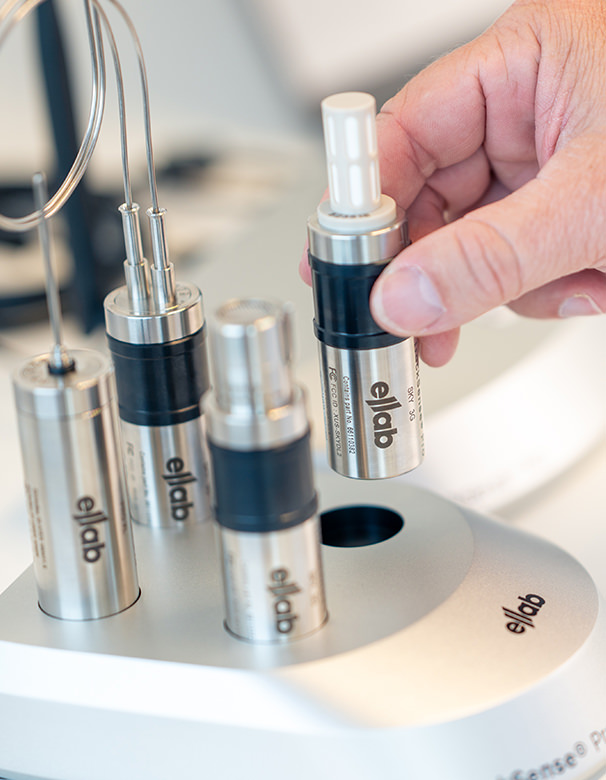
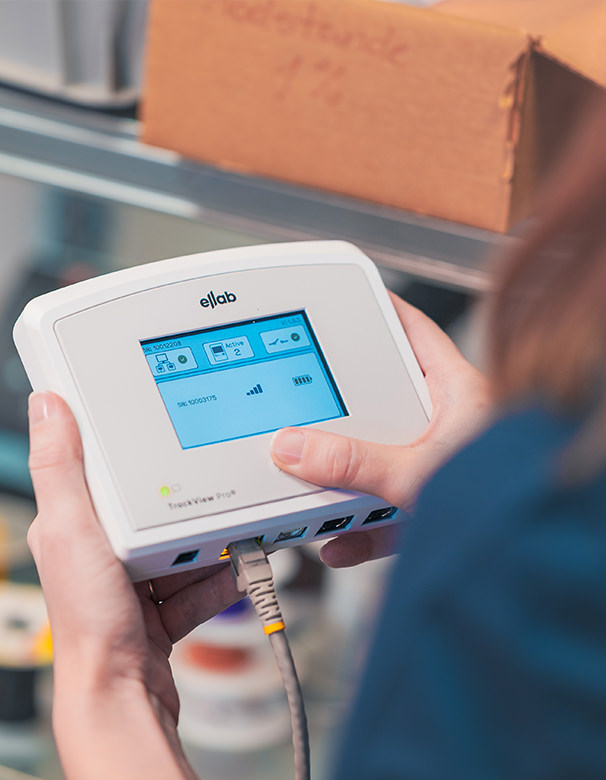
To handle shelf mapping, batch control, and validation of freeze dryers, Ellab offers the TrackSense® LyoPro wireless data logger system.
The TrackSense LyoPro data loggers are specifically designed for freeze-drying applications and enable reliable measurements under demanding process conditions.
With Ellab solutions, you can support reliable shelf mapping and in-vial measurements by using:
- Special stoppers, sensors, and logger nests built for purpose
- Contact puck for accurate shelf temperature measurements
- FDA 21 CFR Part 11 compliant software with automated validation summary reports
- Live data and visualization of the lyophilization process
- Sensors that can be user-calibrated
- Complete audit trail, data integrity, and user control
- On-screen statistical calculations, limit alarms, heat maps, and graphs
These capabilities make the TrackSense LyoPro system well suited as a wireless data logger for lyophilization, allowing you to measure shelf and product temperatures accurately while maintaining the integrity of the freeze dryer chamber.
Validation – The Ellab Way
With more than 400 trained experts worldwide, we have the expertise to support you in every process, anywhere in the world. Tomorrow!
Get in touch with our validation specialists and request a demo of the TrackSense® LyoPro system to see how you can perform reliable temperature mapping and shelf mapping in your freeze dryer.